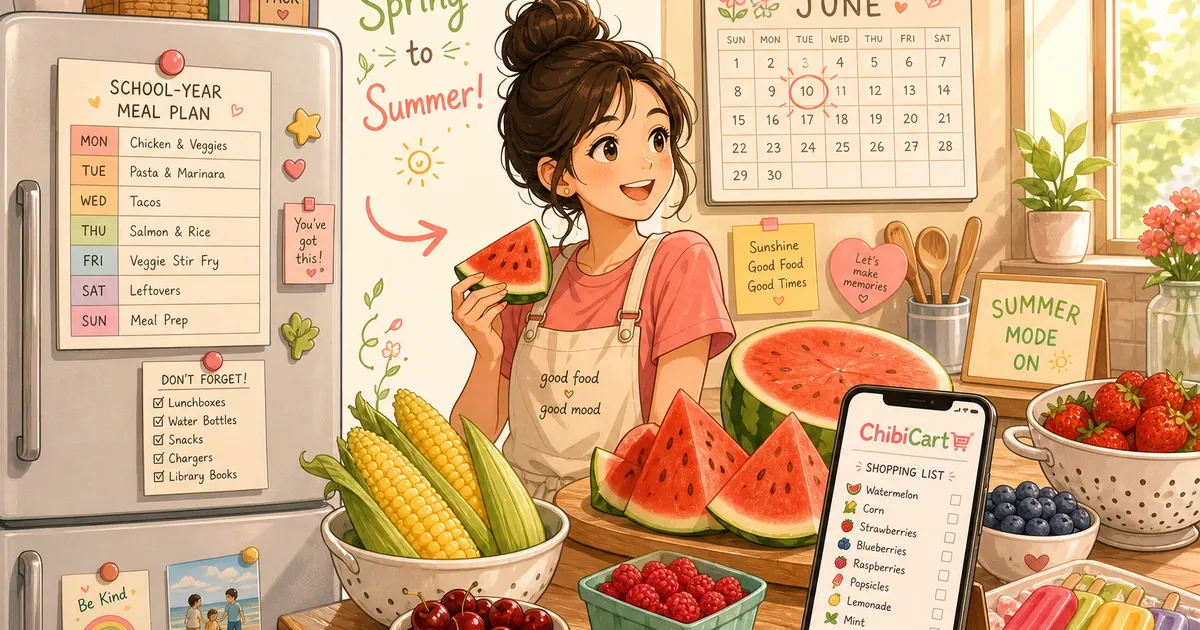
Summer Is About to Break Your Grocery Routine (Here's How to Reset)
You’ve had it dialed. Monday’s meal prep, Wednesday’s quick Target run, Friday’s pizza night. Your grocery routine hums along like a well-oiled machine for nine months straight.
Then school lets out.
Suddenly there are three extra meals a day at home, kids who are hungry at random hours, a fridge that empties by Tuesday, and a schedule that shifts week to week with camps, trips, and “can my friend stay for dinner?” Your grocery system didn’t break because you got lazy — it broke because summer fundamentally changes the inputs.
Here’s how to rebuild it before the chaos starts.
Why Does Summer Wreck Your Grocery Shopping?
During the school year, families operate on predictable loops. Breakfast is fast, lunch is packed or bought, dinner has a rough rotation. Shopping once or twice a week covers it.
Summer blows that up in three specific ways:
- Meal count jumps ~40% — Kids eating lunch and snacks at home adds 7-10 extra eating occasions per week per child (based on historical USDA household food consumption data).
- Schedules become unpredictable — Day camp this week, grandma’s next week, road trip after that. You can’t batch-plan when the headcount changes daily.
- Snack demand explodes — Pool days, bike rides, playdates. Kids burn more energy and graze constantly.
The result? You’re at the store three times a week instead of one, buying random stuff each time, and still hearing “there’s nothing to eat” by Thursday.
The Summer Grocery Routine Reset: A 3-Step System
Forget overhauling your entire meal plan. You need a system that flexes — not a rigid weekly template that breaks the moment plans change.
Step 1: Switch from meals to categories
Instead of planning Monday = tacos, Tuesday = stir fry, think in stocking categories:
- Quick proteins (deli meat, rotisserie chicken, eggs, pre-cooked grains)
- Grab snacks (fruit, cheese sticks, granola bars, carrots + hummus)
- Flexible bases (bread, tortillas, pasta, rice)
- Fresh produce (whatever looks good — buy for 3 days, not 7)
This way, when Tuesday’s plan evaporates because someone got invited to a pool party, you still have mix-and-match ingredients that work for whoever is actually home.
Step 2: Shop shorter cycles
The school-year weekly haul doesn’t work when produce spoils faster in summer heat and your headcount is unpredictable.
Switch to two smaller trips per week. Monday for the first half, Thursday for the second. Each trip is 15 items, not 40. Less waste, less decision fatigue, less “I bought all this food and half of it went bad.”
With ChibiCart, you can keep a running list that updates in real-time — so when your partner notices you’re out of sunscreen and string cheese at 2pm, it’s on the list before you walk into the store at 5pm.
Step 3: Create a summer staples template
Here’s the reset trick that saves the most time: build one reusable summer template and duplicate it each week.
Your summer staples template might look like:
- Watermelon
- Sandwich bread + deli turkey
- Frozen fruit (for smoothies)
- Yogurt tubes
- Chips + salsa
- Hot dogs / burgers (always have grill-ready protein)
- Fresh corn
- Lemonade or iced tea mix
- Sunscreen (yes, it goes on the grocery list)
- Bug spray
Start with this base. Each week, add 5-8 items for whatever specific meals you’re planning. The template means you never forget the summer fundamentals even when the week is chaotic.
How Does a Shared Shopping List Help With Summer Chaos?
Summer’s unpredictability is multiplied in multi-person households. One parent is doing pickup, the other is near Costco, the teenager just finished the last of the bread.
A shared list that syncs instantly means:
- Anyone can add items in real-time — no more texting “can you grab…” photos back and forth
- Whoever is near a store can grab what’s needed — the list is always current
- You can assign sections — one person handles produce, another handles snacks
- Checked-off items disappear — no duplicate purchases even when two people shop the same day
ChibiCart’s real-time sharing was built exactly for this. Your whole household sees the same list, updated instantly, even without a signal in the store’s dead zones.
Summer Grocery Shopping Tips That Actually Work
A few quick wins that compound over the summer:
Buy frozen strategically. Frozen fruit for smoothies, frozen veggies for quick stir-fries, frozen pizzas for the “I can’t deal” nights. They don’t spoil and they’re always there.
Keep a cooler bag in the car. Summer errands + groceries + heat = spoiled dairy. A $12 insulated bag solves this permanently.
Let kids own a list section. Give them a “snack picks” section on the shared list. They choose 3-4 items per week within a budget. Fewer complaints, more buy-in, less “you never get what I want.”
Plan for the grill. If you have outdoor space, grilling 2-3 nights a week in summer is less cleanup, faster cook time, and kids actually eat the food. Keep burger patties, chicken thighs, or veggie skewers as permanent list items.
When Should You Start Your Summer Grocery Reset?
The answer: the week before school ends — not after. If you wait until the first Monday of summer, you’ll spend that entire week reactive and frustrated.
Here’s your timeline:
- This week: Build your summer staples template in ChibiCart
- Last week of school: Do one big stock-up run using the template
- First week of summer: Run the shorter-cycle system (two quick trips)
- Week 2: Adjust the template based on what you actually used vs. what went to waste
By week 3, your new summer rhythm is locked in. No more 9pm panic runs for popsicles.
The Bottom Line
Summer grocery shopping tips come down to one shift: stop planning meals, start stocking categories. Pair that with shorter shopping cycles and a shared list that actually stays current, and you’ve got a system that survives schedule chaos, surprise guests, and the daily “what’s for lunch?” chorus.
Your school-year routine served you well. But summer is a different game — and it starts in a few weeks. Build the new system now, before the old one collapses on day one.