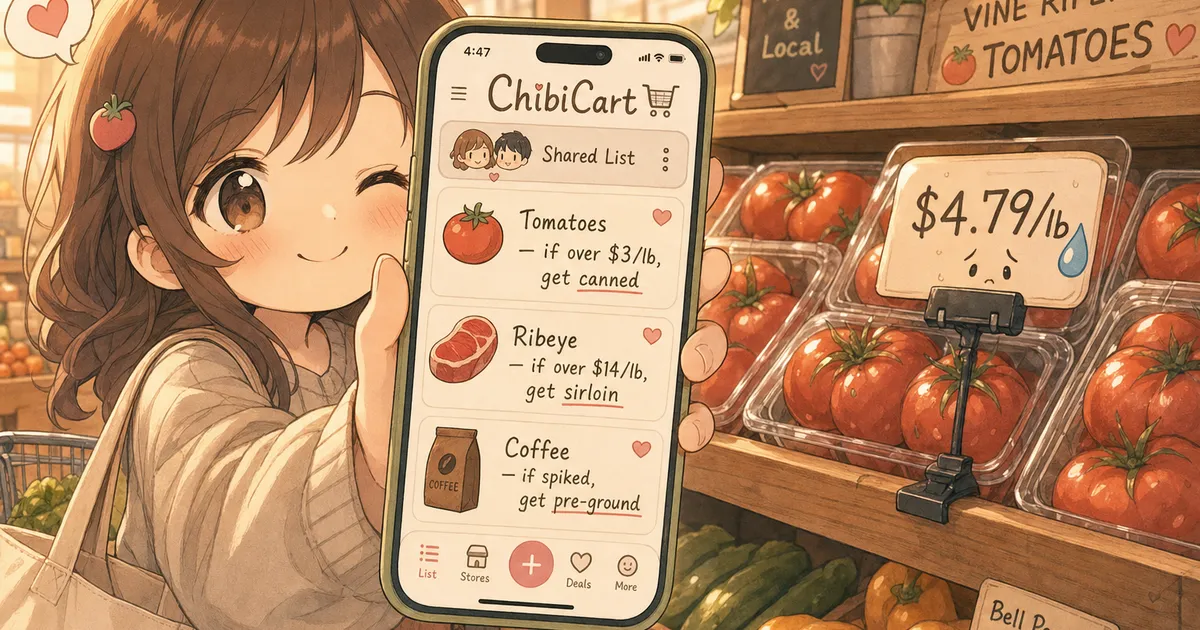
Shopping List Substitutions: Decide the Swap Before You're Alone in the Aisle
You’re holding a clamshell of tomatoes. Last week they were $2.49. This week the sticker says $4.79. Your partner texted get whatever looks good. Behind you, a cart is creaking past. You have about eleven seconds to decide: pay almost double, walk away empty-handed, or improvise something for tonight’s salad — alone, in the aisle, without backup.
This is the moment that broke a lot of grocery budgets in May 2026. Grocery Dive reported on May 16 that grocery inflation hit its highest level since mid-2023, with tomatoes, beef, and coffee leading the spike. But the real problem isn’t the headline. It’s that the headline shows up one item at a time, on a shelf, while you’re holding a shopping list that doesn’t know prices changed.
The fix isn’t a coupon app. It’s a list that already knows what to swap.
What Are Shopping List Substitutions?
Direct answer: a shopping list substitution is a pre-decided swap attached to an item, so the shopper knows what to grab when the first choice doesn’t work. Instead of tomatoes, the list says tomatoes — if over $3/lb, get the canned diced ones in aisle 7. The decision is already made. The aisle stops being a debate.
Most shared lists treat items like dumb tokens. Tomatoes. Beef. Coffee. That works fine when prices are stable and everyone in the household has the same Plan B. It falls apart the moment one of those things stops being true — which, in 2026, has been most weeks.
A shopping list with substitution notes moves the decision out of the aisle and into the calmer moment when you’re building the list at home. You and your partner agree once. After that, whoever shops just reads the note.
Why Pre-Baked Substitutions Beat In-the-Moment Improvising
A few specifics, because vague advice doesn’t survive a real grocery run:
- The aisle is the worst place to make a budget call. You’re tired, the kids are with you or about to be, and the price tag wants you to react. Decisions made at 5:47 PM on a Wednesday tend to skew toward just buy it or forget it entirely — neither of which is the dinner you planned.
- The shopper isn’t always the planner. If your partner is shopping and the asparagus is $7/lb, they don’t know whether to call you, give up, or guess. A note that says if asparagus is over $5/lb, get green beans instead removes all three options — they just grab the beans.
- Memory doesn’t scale to a 30-item list. You can hold one or two swaps in your head. By item 12, you’ve forgotten that you said canned tomatoes were fine. The note is the memory.
- One swap per item is plenty. You don’t need a decision tree. Ribeye — if over $14/lb, get sirloin is a complete instruction. The shopper doesn’t need a backup-to-the-backup.
This is why pre-baked substitutions outperform on-the-fly choices: they convert a stressful, time-pressured decision into a quiet, fully-informed one. You make the call once, and the call rides along on the list.
How to Set Up Substitutions in a Shared Shopping List
This is the part where the app actually has to do its job. In ChibiCart, every item has a notes field — a small space attached to the item itself, not the list as a whole. When your partner taps the item at the store, the substitution is right there.
A practical setup looks like this:
- Open your shared household list at home, before the trip. This is the only step that requires a calm moment. Five minutes on a Sunday is enough.
- Add the items the way you normally would — tomatoes, ground beef, coffee, eggs, bread. Don’t change anything yet.
- For each item that has a price ceiling for you, add a one-line swap note. Short. Concrete. If tomatoes are over $3/lb, get a 28oz can of diced. Not consider alternatives if pricing seems unreasonable.
- Pin the swap to the item, not the list description. A list-level note (we’re trying to keep the trip under $150) gets ignored. An item-level note gets read in the aisle, by the person actually deciding.
- Update notes when last week’s prices stop being true. If beef finally eased and your $14/lb ceiling is no longer triggering swaps, edit the note up to $16. Don’t make your partner shop a January spec sheet in May.
A few examples of swaps that have aged well:
- Tomatoes — fresh; if over $3/lb, get 28oz can diced. (Sauce, chili, soup all fine with canned.)
- Ribeye — 2 steaks; if over $14/lb, get sirloin. (Marinade is doing most of the work anyway.)
- Whole-bean coffee — usual brand; if jumped, get the same brand pre-ground. (Same beans, $2 less, fine for weekday mornings.)
- Strawberries — 1lb; if over $5, get frozen. (Smoothies don’t care.)
- Asparagus — bunch; if over $5/lb, get green beans. (Same side dish, different vegetable.)
Notice what these notes are not: they’re not arguments, they’re not budget speeches, they’re not asking anyone to recalculate the week’s plan in the produce section. They’re just shopping instructions.
How Do Substitutions Work in a Shared List When You’re Not the One Shopping?
Direct answer: the note travels with the item, so whoever opens the list sees the same swap you did. No group text. No phone call. No standing-in-the-aisle interpretation.
This is the household-agreement angle, and it’s the part that matters most. If you decide on Sunday that canned tomatoes are an acceptable substitute, your partner doesn’t have to re-decide that on Wednesday. The list carries the decision. The shared part of the shared list isn’t just the items — it’s the reasoning behind them.
Three quieter habits help too:
- Phrase swaps as instructions, not warnings. If over $3/lb, get canned is a shopping rule. Don’t spend a fortune on tomatoes again is a vibe.
- Trust the swap once it’s on the list. If your partner used the substitution and dinner was fine, the swap is now part of the household’s normal repertoire. Don’t audit it.
- Edit, don’t re-litigate. If a swap stopped working — kid noticed the canned tomatoes, the sirloin was tough — change the note for next time. The list is the source of truth, not a scoreboard.
The shopping trip stops being a quiz. It also stops being a referendum on whose turn it was to remember the budget.
A Note on Offline Reliability
One quick note for the basement-grocery-store case, because shopping list substitutions are useless if the app freezes when you need them. ChibiCart works offline as a Progressive Web App — meaning the list and all its swap notes are already on your phone before you walk in. You can tap into an item, read the swap, and grab the alternative in a dead-zone aisle with no signal. The changes sync up the moment you’re back in range.
This matters specifically for substitutions because the swap is the moment you most need the note. If the app stalls and you can’t see what the household agreed on, you’re back to making a $4.79 decision alone.
The Quiet Win
Grocery prices are going to keep moving — week to week, item to item, sometimes by the day. You don’t need a spreadsheet to keep up. You don’t need to re-plan dinner from a parking lot. You just need a list that already knows what to do when the first choice doesn’t pencil out.
That’s the small but real shift: the list absorbs the decision-making that used to happen in the aisle. The shopper does the shopping. The household stays inside the budget.
If this week’s tomato sticker shock has you side-eyeing the rest of the trip, you don’t need a strategy. You just need a list that carries one small swap per item. Try ChibiCart — it’s free, it works offline, and it has a notes field that quietly outlasts every price spike. 🛒