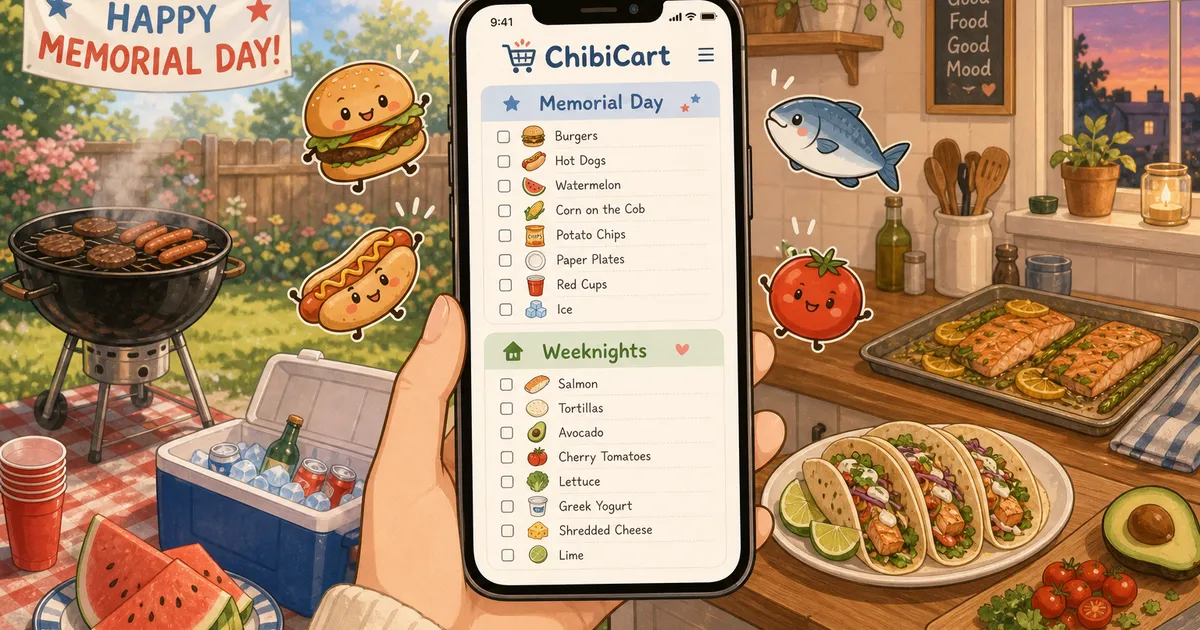
The One Shared List That Handles Memorial Day Week (Cookout + Weeknights)
It’s Tuesday morning, May 19. You stare into the fridge and realize two things at once: Wednesday is taco night, Thursday is leftovers, Friday is pizza — and somewhere in the middle of all that, you’re supposed to feed eight people burgers and potato salad on Monday.
Your brain promptly splits in half.
One half is doing Memorial Day week meal planning — buns, patties, ice, the cooler that’s been in the garage since last summer. The other half is doing the regular weeknight Tuesday-through-Sunday dinner shop. They’re the same week, the same fridge, the same household budget. But they feel like two completely separate shopping trips, and that’s exactly why something always gets bought twice or forgotten entirely.
This is the week-of problem nobody talks about: the cookout isn’t a separate event, it’s threaded into your normal week. And one shared list — properly sectioned — handles both without making your head spin.
Why Memorial Day Week Wrecks Your Shopping Rhythm
Most cookout advice treats the holiday like an island. “Here’s your BBQ list. Here’s how to coordinate with guests.” Useful, but it ignores the boring reality: you still have to feed your family the other six days of the week.
Memorial Day week breaks the rhythm in three specific ways:
- Two shops collide. The cookout shop wants bulk (buns x 24, ice x 4 bags). The weeknight shop wants precision (one zucchini, half a pound of ground turkey). Mixing them in one cart leads to over-buying or under-buying both.
- The fridge has to flex. You normally have a Tuesday-Sunday meal plan. Monday is now a 24-person event. Tuesday’s leftovers either become Wednesday’s lunch — or they go to waste because your spouse already started the next week’s prep.
- Two shoppers, two memories. One person mentally tracks the cookout. The other tracks the weeknights. By Saturday, both are convinced the other one bought the eggs.
According to USDA household food consumption data, US households shop for groceries about 1.6 times per week on average. Memorial Day week pushes most households to three or four trips — and each extra trip is where duplicates and forgotten items quietly multiply.
What’s the Best Way to Plan Memorial Day Week Shopping?
The direct answer: Use one shared shopping list with two clearly labeled sections — “Memorial Day” and “Weeknights” — and have everyone in your household add to it in real time.
Not two lists. Not a spreadsheet. Not a group text. One list, two sections, both visible to everyone.
Why one list with sections beats two separate lists, every time:
- Shared items only get bought once. Eggs, milk, butter, ice — these show up on both mental lists and almost always get duplicated when the lists live in two places.
- You see the whole week at once. When the cookout and the weeknight dinners are on the same screen, you naturally adjust. Leftover burger patties become Wednesday’s tacos.
- Whoever’s at the store handles whatever section they’re closest to. One person hits Costco for the bulk cookout items, the other does the weeknight grab at Trader Joe’s, no overlap.
- Adding a forgotten item is one tap. “Oh, we need lighter fluid” → tap, type, done. The other shopper sees it before they leave their store.
ChibiCart was built for exactly this — one shared list, real-time updates between household members, sections you can name yourself, and it works offline when you’re in a Costco basement with no signal. No account required for the second person; they just open the link.
The Memorial Day Week Shared List Template
This is the structure that holds up across one cookout, four weeknight dinners, and roughly $180-$240 in groceries for a family of four hosting eight people on Monday.
Section 1: Memorial Day (Shop by Sunday May 24)
The big cookout dump. Lock this section by Saturday so nobody’s panic-buying buns at 9 AM on Monday.
Grill
- Burger patties (1/3 lb) x 12
- Hot dogs x 16
- Hamburger buns x 12
- Hot dog buns x 16
- Cheese slices x 16
- Charcoal or propane (check tank Saturday)
Sides & Drinks
- Potato salad (3 lbs) or ingredients to make
- Watermelon, whole x 1
- Chips, 2 large bags
- Condiments: ketchup, mustard, BBQ sauce
- Drinks: water bottles x 24, soda variety x 12, beer/seltzer x 12
Ice & Supplies
- Ice bags x 3 (buy Monday morning)
- Paper plates x 30
- Napkins x 60
- Cups x 24
- Trash bags x 3
Section 2: Weeknights (Tuesday May 19 — Sunday May 24)
The normal life shop. Built around 4-5 actual dinners, not vibes.
Tuesday — Taco Night
- Ground turkey, 1 lb
- Taco shells, 1 box
- Lettuce, tomato, salsa
- Black beans, 1 can
Wednesday — Sheet Pan Salmon
- Salmon fillets x 4
- Asparagus, 1 lb
- Lemon, 1
Thursday — Leftovers Night (no shopping needed)
Friday — Pizza Night (takeout — no shopping needed)
Sunday — Pre-Cookout Lighter Dinner
- Rotisserie chicken, 1
- Bagged salad x 2
- Sourdough loaf
Pantry / Shared with Memorial Day section
- Eggs, 1 dozen (also used for potato salad)
- Milk, 1 gallon
- Butter, 1 lb (also used for buns and corn)
- Bananas, fruit, lunch snacks
Notice how the Pantry items quietly get used by both sections. That’s the whole point — one fridge, one budget, one list.
How to Split the Shopping Between Two People Without Doubling Up
This is where the shared list does its quietest, most useful work.
Step 1: Build the full list together Sunday night. 15 minutes, both phones out, both sections populated. This is the only “meeting” the week needs.
Step 2: Tag who’s shopping which section. “Memorial Day — me, Saturday Costco run.” “Weeknights — partner, Wednesday Trader Joe’s stop.” If your list app lets you claim items by name, use it.
Step 3: Anything claimed disappears from both phones in real time. The moment one person crosses off “butter,” the other person sees it before they walk past the dairy aisle.
Step 4: Add to the list across the week as gaps surface. Wednesday afternoon you notice you’re out of paper towels — tap, add, your spouse picks it up Thursday. Saturday morning you realize you forgot lighter fluid for Monday — tap, add, somebody grabs it on the next run.
Step 5: Archive Monday night. After the cookout, archive or clear the Memorial Day section. The Weeknights section keeps rolling into next week.
A group text version of this involves roughly 22 messages, two miscommunications, and one duplicate gallon of milk. The shared-list version takes about 90 seconds of total typing across the week.
What If You’re a Solo Shopper or a Couple Without Kids?
Same system, scaled down. Even with one shopper, the two-section split prevents the most common Memorial Day mistake: buying the cookout stuff so far in advance that the weeknight dinners get neglected, then ordering takeout three nights in a row because the fridge is full of buns and ice.
For a couple hosting four guests instead of eight: halve the grill quantities, drop one weeknight dinner, keep the structure. The point isn’t the headcount — it’s the brain-splitting.
The Real Memorial Day Week Win
The goal isn’t a perfect cookout. It’s that on Tuesday May 26, the day after the holiday, you open the fridge and find:
- No mystery leftovers from Monday that nobody will eat
- Enough food to coast through Tuesday and Wednesday
- A weeknight section that already has Thursday’s dinner queued up
- A grocery budget that didn’t quietly double because of duplicate buys
Memorial Day week is supposed to be a long weekend with a kickoff cookout — not a four-day grocery scramble. One shared list, two sections, and the whole week stops feeling like two competing brains in the same kitchen.
If you want to try this with your household, ChibiCart lets you build a sectioned list, share a link with whoever else cooks or shops, and watch it update live as items get claimed. Works offline in the warehouse aisle. No accounts. Free.
Good week ahead. Save the energy for the burgers.