When Someone in the House Is on a GLP-1, the Shopping List Does the Heavy Lifting
It’s Sunday afternoon. One of you is on a GLP-1 — the appetite is genuinely smaller now, the cravings are quieter, and the cookie aisle isn’t the gravitational event it used to be. The other one of you still wants the cookies. The kids want what the kids want. And the three of you are about to walk into the same store with the same cart.
This week, that household just got a lot more common. On May 18, 2026, Food Navigator USA reported on a new oral GLP-1 breakthrough — a pill version that broadens the addressable cohort well beyond the injectable user base. Translation: a lot more kitchens are about to be doing the dance where one person’s appetite quietly changed and the rest of the house didn’t.
This isn’t a medical post. ChibiCart isn’t a clinic. But it turns out a GLP 1 grocery shopping list is the small piece of household coordination that keeps Sunday from turning into a negotiation in aisle six.
Why a GLP 1 Grocery Shopping List Is Really a Household Tool
Most of the GLP-1 advice online is written for the person taking the medication. Smaller portions. Protein-forward. Less ultra-processed stuff. All true, all useful — and all completely ignoring the fact that very few GLP-1 users live alone.
The person on the medication has a plan. The household has a fridge. The list is where those two things have to meet.
A shared GLP 1 grocery shopping list is just a regular shopping list with three small adjustments:
- Quantities written down per item, because “a few” means something different to someone whose appetite is half what it was last year.
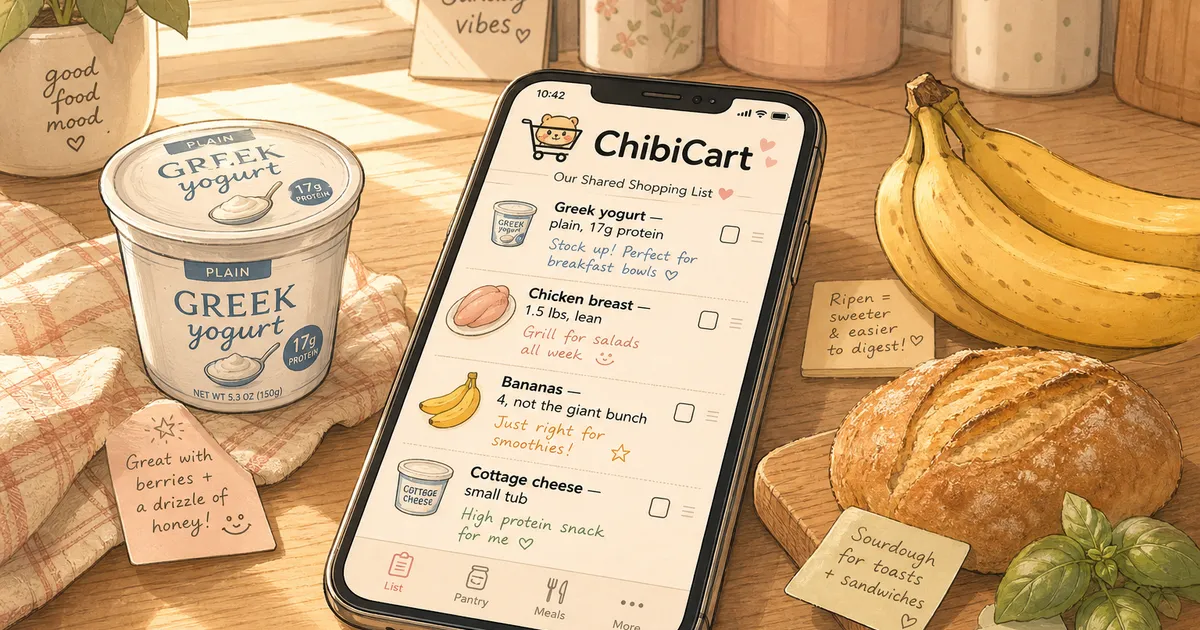
- Per-item notes for protein-forward swaps, so the shopper isn’t guessing whether yogurt means the strawberry kind or the plain Greek with 17 grams of protein.
- A clear separation between “everyone food” and “this person’s food,” so nobody feels like the whole pantry has to be renegotiated every week.
The list does the coordination. Nobody has to be the spokesperson for someone else’s appetite.
What Actually Goes on the List
Here’s the practical version. Say one adult in the house is on a GLP-1, the other isn’t, and there are two kids who eat like kids. A week’s list might include items like these — same list, different per-item notes:
- Greek yogurt — plain, 0% or 2%, 17g protein per cup. (The strawberry one is fine for the kids.)
- Chicken breast — 1.5 lbs, lean cut. (Two meals, smaller portions.)
- Eggs — 18-pack. (Breakfast protein for everyone.)
- Cottage cheese — small tub, low-sodium.
- Bananas — 4, not the giant bunch.
- Sourdough — small loaf, half goes in the freezer.
- Cookies — the usual, kids’ lunches. (Yes, on the list. No, not a problem.)
- Sparkling water — case, plain or lemon.
Notice what these notes are not: they’re not a diet plan. They’re not a sermon. They’re not asking anyone to give up the cookies. They’re shopping instructions — the same kind you’d write for “organic eggs” or “large yellow onions.”
The person on the GLP-1 doesn’t have to text please don’t get the giant bunch of bananas, I can’t eat them before they go bad. The note is on the list. The shopper sees it. The bananas come home in a quantity that gets eaten.
How Do You Set This Up Without Making It a Whole Thing?
Direct answer: put the GLP-1-specific information in the per-item note, not in a separate list, and let whoever shops just shop. A second “diet list” gets ignored within a week. A note attached to the item gets read in the aisle.
In ChibiCart, every item on a shared list has its own notes field — a small space attached to the item, separate from the item name. The notes sync in real time across every device sharing the list, so whoever shops sees the same instructions.
A practical setup looks like this:
- Use one shared household list, not two. Don’t fork into “his list” and “her list.” That’s how resentment starts.
- Add the item the way you normally would — yogurt, chicken, bananas.
- Tap into the item and add a one-line note for the GLP-1-relevant detail — plain Greek, 17g protein or 1.5 lbs, smaller portions.
- Write quantities for the items where it matters. Smaller appetite means smaller pack sizes, more frequent restocks. Eight bananas this week, not sixteen.
- Don’t note things that don’t need noting. The toilet paper does not need a GLP-1 note. Keep the friction low.
The shopper opens the list at the store and reads exactly what to buy. The person on the medication isn’t dictating from the couch. The list does the dictating.
The Three Most Useful Notes to Write
If you only add three kinds of per-item notes, make them these:
- Protein number. 17g per cup. 25g per serving. It’s the single most useful piece of info for anyone on a GLP-1, because protein is what the meds-plus-appetite-shift combo most often leaves underweight.
- Quantity downshift. 4, not 8. Small loaf, not the family one. Smaller appetite means smaller packs. The list keeps that from turning into wasted food.
- Lean / plain / unsweetened. Lean cut. Plain Greek. Unsweetened almond milk. Three words that prevent six confused texts.
That’s it. Three note types, used selectively, on items where they actually matter. The rest of the list stays normal.
What This Doesn’t Try to Be
A quick note for honesty’s sake. ChibiCart doesn’t track macros. It doesn’t talk to your doctor. It doesn’t know what GLP-1 you’re on or what dose. It’s a shopping list. Specifically, it’s a shopping list that other people in your house can also see and edit, with a notes field on each item.
That narrowness is the point. The medical part of GLP-1 management belongs with your prescriber. The household part — the cookie aisle, the cottage cheese, the can you grab a small loaf instead of the family one — belongs on a shared list. We’re just trying to make that part less of a Sunday afternoon project.
And because grocery stores love a dead zone, the list works offline as a PWA (Progressive Web App, basically a website that runs on your phone like a regular app). The notes are on the device before you walk in. You can read “plain Greek, 17g” while standing in front of the dairy case in a basement-level Trader Joe’s with no signal. The list syncs the moment you’re back in range.
The Quiet Win
When one person in the house is on a GLP-1, the temptation is to either reorganize the whole pantry around it or pretend nothing changed. Neither works. The first turns dinner into a project; the second leaves the person on the medication doing all the coordination by group text.
A GLP 1 grocery shopping list — really, just your normal household list with a few useful notes — splits the difference. The cookies stay. The bananas come home in a count that gets eaten. The Greek yogurt is the kind with the protein number on it. Nobody has to be the spokesperson for someone else’s appetite.
If this is your house right now, you don’t need a meal plan. You just need a list that carries a few small notes the rest of the household can read. Try ChibiCart — it’s free, it works offline, and it has a notes field that’s about to do a lot of quiet work for your kitchen. 🛒