When a Food Recall Hits, Future-You Will Wish You'd Written That Down
It’s Friday morning. You’re scrolling the news with one eye and packing a lunch with the other. A headline catches you sideways: an E. coli recall. Stores you’ve actually walked into. You squint at the fridge. Was that the romaine from last Saturday? Which store did we go to — the one near the park or the one on the way to soccer? Whose turn was it to shop? You stand there holding a half-zipped lunchbox, trying to reconstruct seven days of grocery decisions from memory.
This week made that scene very specific. On May 15, Supermarket News reported that H-E-B and Sprouts are both tied to active E. coli recalls, with at least nine people infected across multiple states. If you shop at either chain — or just shop near someone who does — your group chat probably already has a did we buy that? somewhere in it.
This post isn’t a panic piece. It’s about the small writing habit that turns a recall headline from a 20-minute archaeology dig into a 30-second check.
Why a Food Recall Shopping List Habit Beats a Memory Test
When a food recall hits, three things matter, fast: what brand, what store, and roughly when. If those three things are sitting on your phone — already, for every grocery run — you’re done in under a minute. If they’re not, you’re cross-referencing receipts, bank statements, and your partner’s foggy recollection of last Saturday.
A food recall shopping list isn’t a special list. It’s just your normal shopping list with three extra characters per item. The trick is putting brand and store into the list itself, instead of relying on whoever-shopped-that-day to remember.
A few examples of what this actually looks like in practice:
- Romaine — H-E-B, organic clamshell.
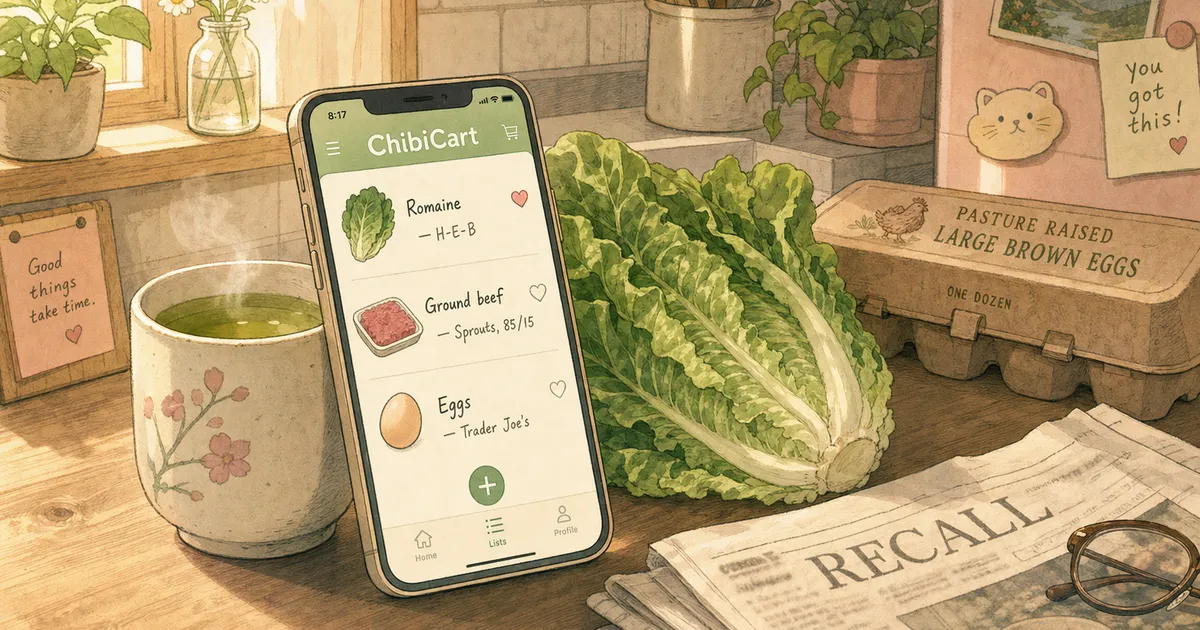
- Ground beef — Sprouts, 85/15.
- Eggs — Trader Joe’s, cage-free dozen.
- Spinach — Costco, big bag.
- Rotisserie chicken — Sprouts, plain.
That’s it. Four extra words per item. Your past-self does the writing; your future-self does the worrying-less.
What’s Actually Useful to Note (and What’s Overkill)
For recall-readiness specifically, here’s the short version of what to write down — and what’s not worth the keystrokes.
Worth writing every time:
- Brand or store-brand line. H-E-B Organics, Sprouts Brand, Kirkland. Most recalls list a specific brand.
- Store you bought it at. Especially for fresh produce, meat, and dairy, where the recall often names the retailer.
- The product line. Organic baby spinach vs. frozen creamed spinach — different recalls, different aisles.
Worth writing when it’s easy:
- Lot or sell-by date — but only for the handful of items where you genuinely care (baby formula, supplements, anything for someone immunocompromised). Otherwise it’s friction that kills the habit.
Skip:
- Receipts. They fade, they get lost, they don’t tell you what “the green bag thing” was.
- A separate tracking app. If it’s not where you already shop, you won’t keep it up.
The whole point is that the note rides along with something you’re already doing. Open the list. Add the item. Add four words. Move on.
How Do You Actually Build the Habit Without Adding Friction?
Direct answer: put the note on the item, not in your head, and do it at the moment you add the item — not later. That’s the entire system. Every other version of this fails within a week.
Three small rules that make it stick:
- Write the note when you add the item, not at checkout. Memory is freshest when you’re typing “romaine” into the list. By the time you’re in the parking lot juggling bags, you’ve already forgotten which store had the deal.
- Use the same shorthand every time. H-E-B, not sometimes HEB and sometimes the H-E-B on Mopac. Future-you searching for “H-E-B” in a recall scramble shouldn’t have to guess your own spelling.
- Let the shopper edit, not just the planner. If your partner ended up at Sprouts because H-E-B was out, they should be able to update the note in 5 seconds. Otherwise the list lies, and a lying list is worse than no list.
In ChibiCart, each item has its own notes field — a small space attached to the item, separate from the item name. Whoever shopped can tap in and update which store, which brand the moment it changes. The notes sync to every device sharing the list, so the household has one source of truth instead of three different memories.
To be straight with you: ChibiCart doesn’t have a recall-alert feature. Nothing pings you when the FDA posts something. What it does have is a notes field that makes the manual check fast. When the headline drops, you open the list, search the brand or store, and you have your answer before the kettle boils.
A 30-Second Recall Check, Step by Step
Let’s make this concrete. Say tomorrow morning a recall lands on, hypothetically, a specific brand of bagged lettuce sold at Sprouts.
- Open your shared list. The current week, plus the last two if you keep an archive.
- Search the brand or store name. Sprouts. Bagged lettuce. Whichever the recall specifies.
- Scan the matches. Three items? You bought it. Zero matches? You didn’t, or you didn’t note it — which is its own answer (assume yes, check the fridge).
- Cross-check the fridge. The list told you whether. The fridge tells you if it’s still there.
- Toss, refund, or relax. Recalls usually offer refunds with a receipt or even just a photo of the package. The list told you to look; the package tells you the lot.
Thirty seconds. No archaeology. No “babe, do you remember if we got the pre-washed kind or the head?”
Why This Actually Sticks (When Most Habits Don’t)
Most “track everything” advice fails because it treats the household like a database. Real households are tired. The system has to fit between getting the kids in the car and grabbing coffee on the way out. Four extra words on a list you’re already making is about the only food-safety habit small enough to survive a Wednesday.
It also has compounding interest. The first month feels pointless — no recall happens, no payoff. Three months in, you can scan a list and tell which store you tend to use for produce, which brand of yogurt you keep coming back to, what you bought for the in-laws’ visit in March. The recall use case is the headline; the everyday use case is just knowing what you actually buy.
For offline shopping — basement-level grocery stores love a dead zone — ChibiCart keeps the list and all its notes on your phone as a PWA (Progressive Web App, basically a website that works offline like a regular app). You can pull up the brand of the bread you bought last Saturday while standing in front of the bakery shelf, with no signal. The notes are there because you wrote them on Saturday, not because the network is cooperating right now.
The Quiet Win
Recalls are going to keep happening — this week’s H-E-B and Sprouts story is just the latest one with names you recognize. You can’t prevent any of it from your kitchen. What you can do is make the moment after the headline less stressful, by putting four extra words next to the item the first time you add it to the list.
Future-you, three months from now, mid-coffee, reading some new headline about some new recall — that’s who you’re writing for. They’re going to be very glad you did. Try ChibiCart — it’s free, it works offline, and it has a notes field that quietly turns your shopping list into the receipt you’ll wish you had. 📝