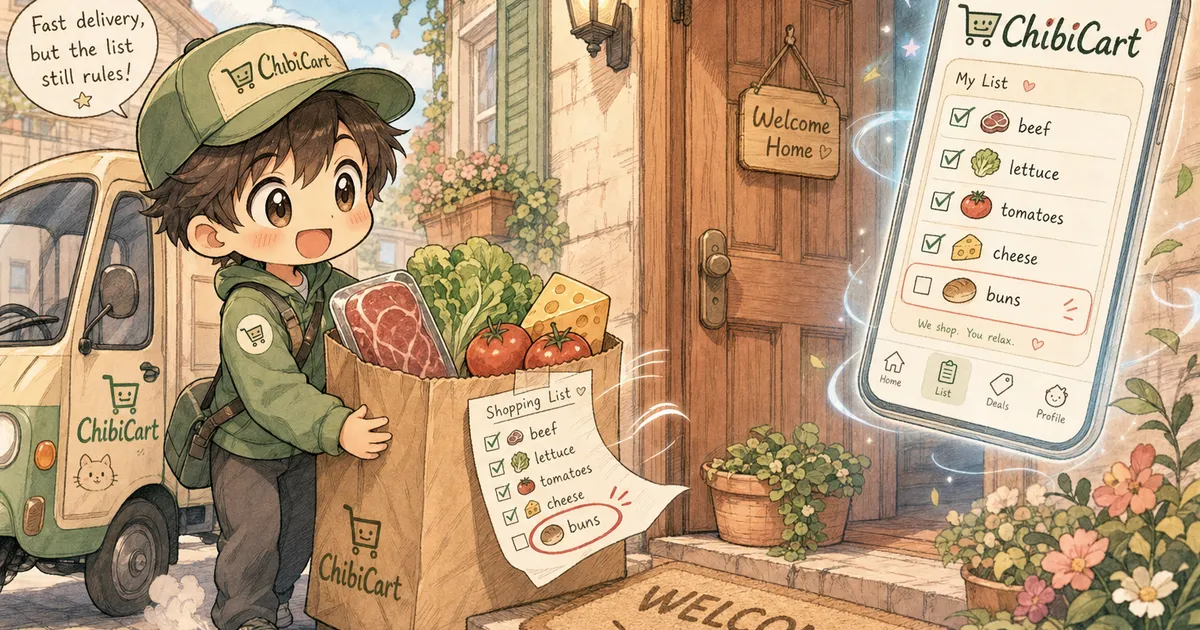
Amazon Will Deliver Groceries in 30 Minutes. You'll Still Forget the Buns.
You’re hosting six people for burgers tomorrow. You order beef, cheese, lettuce, tomatoes, pickles, ketchup, and chips through Amazon’s new 30-minute grocery drop. The driver pulls up before the ice cream melts. You feel like a wizard. 🛒
Then, an hour before guests arrive, you realize: no buns.
This week, Amazon expanded its 30-minute grocery delivery and same-day perishable service to over 2,300 U.S. cities. The pitch is that speed solves grocery shopping. But faster delivery doesn’t fix the part that actually breaks most grocery runs — the part where you forgot something you needed three days ago.
Shopping List vs Grocery Delivery: What Actually Solves Forgetting?
The honest answer to shopping list vs grocery delivery isn’t “pick one.” It’s that they solve completely different problems.
- Grocery delivery solves time. Driving, parking, walking the aisles, waiting at checkout. Gone in 30 minutes.
- A shopping list solves memory. What you need, who already added it, what’s already in the fridge, what your partner promised to buy yesterday.
When you forget the buns, no delivery service in the world can fix it — because the gap was never between you and the grocery store. The gap was between the moment you noticed you were low on buns and the moment you placed the order. That gap is where lists live.
Fast delivery is a courier. A list is a memory layer. You need both, and the courier can’t replace the memory.
Why Faster Delivery Makes Lists More Important, Not Less
It’s tempting to think 30-minute delivery makes planning obsolete. The opposite is true. Here’s why:
1. Delivery rewards complete orders. A single Amazon Fresh trip with 12 correct items costs the same delivery fee as one with 4. If you forget half your list and re-order an hour later, you pay twice — in fees, in driver time, and in the kind of low-grade decision fatigue that makes you skip dinner.
2. Speed shifts the bottleneck to the human brain. When the store is 30 minutes away, the limiting factor was logistics. When the store is 30 minutes away delivered, the limiting factor becomes how completely you remember what your household needs. That’s a memory problem, not a delivery problem.
3. Households still don’t share a brain. Your partner used the last of the milk this morning. Your roommate finished the eggs. The kid drank the last juice box. Unless that information lives somewhere you can both see, the fastest delivery service in the world will arrive missing the three things you actually needed.
A fast courier without a shared list is just a more expensive way to forget the same items, faster.
How a Shared List Closes the Gap (Even at 30-Minute Speeds)
This is where a real shopping list app — one designed for households, not solo errands — earns its keep. Here’s the workflow that pairs cleanly with same-day delivery:
Step 1: Capture the moment you notice. You finish the milk. You add it to the list right then, on your phone, in five seconds. Not later. Later is where forgotten buns live.
Step 2: Let your household add too. Your partner notices the laundry detergent is almost out. They add it. You don’t have to know — the list does.
Step 3: When it’s time to order, you have the full picture. Open the list. Everything anyone has noticed in the last week is right there. Order it. Delivery handles the rest.
This is exactly the gap ChibiCart is built to close. You add items the second you think of them — by typing, by voice while your hands are full, or by snapping a receipt to restock what you just used. Your partner sees the update in real time. The list works in basements and parking lots where the signal drops, because it’s offline-first. It’s the memory layer that sits between “I noticed we need this” and “the courier is at the door.”
Quick Answer: Should You Stop Using a Shopping List Now That Delivery Is Fast?
No. Faster delivery makes a shared shopping list more useful, not less. Here’s the short version:
- Use delivery for: the trip itself — saving 60-90 minutes of driving, parking, and aisle-walking.
- Use a shared list for: capturing items the moment anyone in your household notices them, so the order you place is actually complete.
- Use both together: open the list when it’s time to order. Everything you and your partner noticed all week is right there. One delivery, no second trip.
A single forgotten ingredient costs you a second delivery fee, a second 30-minute wait, and the small but real frustration of the meal being delayed. A shared list costs nothing and prevents nearly all of those misses.
A Small Practical Setup for the 30-Minute Era
If you’ve started using same-day grocery delivery, these are the habits that make it actually work:
- One shared list per household. Not three. Not “his and hers.” One list everyone adds to. (This is the single biggest fix for duplicate purchases.)
- Add items the moment you notice. The instant the carton feels light. The instant the spice jar rattles empty. Not “later.”
- Voice input for hands-free moments. Cooking, driving, holding a baby — say what you need, the list captures it.
- Glance at the list before you tap “order.” Five seconds. That’s the whole habit. It catches the buns.
- Keep the list in one place. Switching between sticky notes, Notes app, and three text threads is how things get missed. Pick one app and put it on the home screen.
None of this requires a delivery service. All of it makes a delivery service work the way the marketing promises.
The Real Promise of Fast Delivery (And Where It Falls Short)
The genuine win of 30-minute grocery delivery is reclaimed time. An hour you didn’t spend pushing a cart is an hour back for dinner with your kid, a walk, a longer evening. That’s real, and it’s worth using.
What fast delivery can’t do is remember things for you. It can’t notice the milk is low. It can’t know your partner used the last of the bread this morning. It can’t tell you that the recipe you’re cooking on Thursday calls for buns you don’t have.
Those are jobs for a list — specifically, a list shared with the people you live with.
The shopping list isn’t the old-fashioned thing the delivery apps will replace. It’s the thing that finally makes those delivery apps deliver the right groceries.
Give your household a shared list this week. Then watch how much smoother that 30-minute drop feels when nothing’s missing from it. 🛒✨
Want to try a shopping list built for shared households, voice input, and offline reliability? Open ChibiCart — no account, no subscription, just a list that remembers for you.