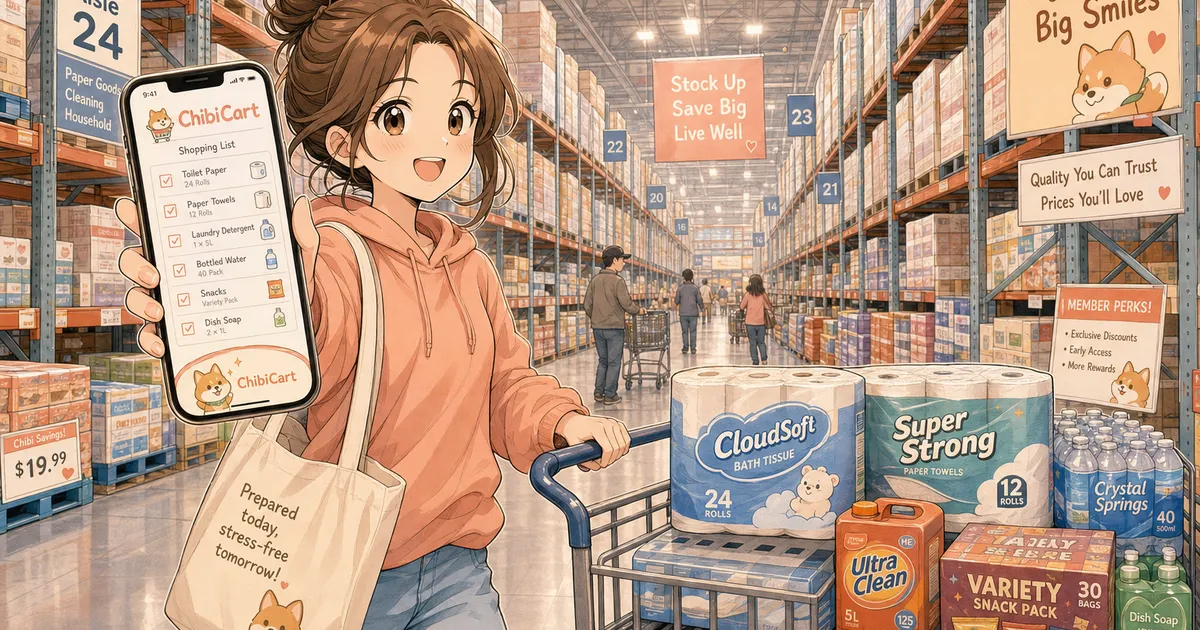
How to Survive Costco With a Shopping List (Not a Treasure Map)
You walked into Costco for paper towels and chicken. You walked out with a kayak, a 5-pound bag of dried mango, a cashmere sweater, and no paper towels. The chicken? You forgot about it somewhere between the book display and the industrial-sized jar of olives. 🛒
This isn’t a personal failing. It’s what Costco is designed to do. And your regular grocery list doesn’t stand a chance in there.
Why Does Your Normal Grocery List Fail at Costco?
A standard grocery list assumes a predictable store. Consistent aisles, consistent stock, consistent layout. Walk in, check items off, walk out.
A Costco shopping list needs an entirely different approach because warehouse stores break every assumption your grocery list relies on:
- The layout changes constantly. Costco deliberately rotates product placement to force you through unfamiliar paths. The peanut butter was on aisle 7 last month — now it’s on aisle 12.
- Everything is oversized. You’re not grabbing “a bag of chips.” You’re deciding whether you have room for 40 individual-serving bags of chips.
- The treasure hunt is the business model. Limited-time items, end-cap displays, seasonal rotations — Costco’s $7.7 billion in annual membership fees are subsidized by the impulse purchases their layout generates.
- Bulk math is genuinely hard. Is $14.99 for 3 pounds of strawberries a good deal? Do you even eat 3 pounds of strawberries before they mold?
A regular checklist doesn’t address any of this. You need a strategy, not a list.
How to Build a Costco Shopping List That Actually Works
The warehouse-proof method has 5 components. Each one addresses a specific Costco trap.
1. Zone your list, don’t aisle-sort it.
Costco layouts cluster by zone, not by traditional grocery logic. Group your items by warehouse section:
- 🧊 Cold zone (back wall): meat, dairy, eggs, produce
- 📦 Center aisles: pantry staples, snacks, beverages
- 🧻 Outer ring: paper goods, cleaning, household
- ❄️ Frozen: frozen meals, ice cream, frozen fruit
- 🏷️ Front seasonal: rotating items, clothing, electronics
This matters because Costco is enormous — 146,000 square feet on average. Backtracking across that space wastes 15-20 minutes per missed zone.
2. Add quantity limits to every item.
The biggest Costco budget-buster isn’t impulse buying — it’s buying the right item in the wrong quantity. Next to each item, write the max you’ll buy:
- Paper towels — 1 pack (you already have half a pack at home)
- Chicken thighs — 1 tray (freezer space: one shelf)
- Olive oil — ONLY if under $15/liter
Quantity limits turn vague “I need chicken” into a concrete decision boundary.
3. Set a hard budget before you walk in.
The average Costco trip costs $100-$150. Without a number in your head, the flatbed cart makes everything feel reasonable. Write your budget at the top of your list. Running total as you go.
A cart with 8 items at Costco can hit $200 without a single luxury purchase. Knowing your number keeps bulk deals from becoming bulk regret.
4. Mark the “treasure hunt” items separately.
Some Costco trips have a treasure-hunt component: seasonal items, limited finds, things you’ve been watching for. Separate these from your essentials:
- ✅ Need — won’t leave without these (paper towels, chicken, eggs)
- 👀 Watch for — only if you spot them (that Korean BBQ sauce, seasonal candles)
- 🚫 Don’t even look at — your known weakness aisles (electronics, books, clothing)
This gives you permission to browse intentionally — without pretending you’re “just looking” at a $400 Roomba.
5. Split bulk items with your household plan.
Before buying the 5-pound bag of spinach, answer: who’s eating this, and by when?
- Splitting a Costco haul with a roommate or family member? Note who gets what.
- Meal prep the bulk protein within 48 hours? Mark it.
- Can you freeze the overflow? Plan the container space.
Bulk buying without a consumption plan is just paying for food waste in advance.
What’s the Real Cost Difference? A Quick Comparison
| Item | Grocery Store | Costco | Worth It? |
|---|---|---|---|
| Eggs (24) | $7.50 | $5.99 | ✅ Always |
| Olive oil (1L) | $12 | $9.50 | ✅ If you cook often |
| Strawberries (3 lb) | $9 (1 lb × 3) | $8.99 | ⚠️ Only if you’ll eat them |
| Paper towels (12 rolls) | $18 | $21 (but 30 rolls) | ✅ Per-unit savings |
| Rotisserie chicken | $8-9 | $4.99 | ✅ The Costco loss leader |
The savings are real — but only if you buy what you’ll actually use. A Costco shopping list with quantity limits prevents the “it’s a deal!” trap that fills your pantry with things that expire before you touch them.
The Pre-Trip Inventory Check (5 Minutes That Save $50)
Before writing your Costco shopping list, do a 5-minute scan:
- Freezer space — physically look. If you can’t fit another bag of frozen chicken, don’t buy it regardless of price.
- Pantry bulk items — how much is left of what you bought last trip? If the rice is half-full, skip it.
- Fridge consumption — did you actually eat the 2-pound container of hummus from last time?
This check prevents the most common Costco mistake: buying duplicates of bulk items you haven’t finished. It’s not a deal if you’re throwing away the last third.
How to Handle the Costco Checkout Impulse Zone
The front of Costco — books, clothing, electronics, seasonal items — is placed so you walk through it on the way out. Post-checkout satisfaction is low (you just spent $150), so “one more thing” feels harmless.
Strategy: Route your exit path. If your weakness is books, leave through the side door. If it’s seasonal items, don’t slow down in the front zone. Build your list to end in the cold section (back of store), so your route naturally exits away from impulse territory.
Making Your Costco Shopping List Work on the Go
Warehouse shopping has a specific challenge that regular grocery runs don’t: you’re pushing a flatbed cart the size of a small boat through crowds while trying to check a list on your phone.
ChibiCart handles this because your list works offline — no hunting for signal in a warehouse with concrete walls and 50-foot ceilings. Check items off one-handed while steering the cart with the other. Share the list with whoever you’re splitting the haul with so they can see what’s checked off in real time. 📱
And if you’re doing that pre-trip inventory check, voice input lets you walk through your pantry and speak items directly into your list — “add paper towels, one pack max” — without stopping to type.
Costco Shopping List Template
Here’s a ready-to-use ChibiCart list structure for your next warehouse run:
🧊 Cold Zone (hit first — perishables)
- Rotisserie chicken × 1
- Eggs (24 ct) × 1
- Chicken thighs — 1 tray, freeze half
📦 Center Aisles
- Olive oil — only if under $15
- Coffee beans × 1 bag
- Rice — skip if current bag is >⅓ full
🧻 Household
- Paper towels × 1 mega pack
- Trash bags — check garage stock first
👀 Watch For (not essential)
- Korean BBQ sauce (seasonal — if spotted)
- Wool socks (only if on clearance)
Budget: $120 max | Running total: ___
Copy this structure into a list app that won’t die when you hit the dead zone between the tire center and the walk-in dairy cooler.
The Warehouse Store Isn’t a Grocery Store With Bigger Packages
Costco, Sam’s Club, BJ’s — these aren’t grocery stores. They’re retail experiences engineered to make you buy more than you planned. The $4.99 rotisserie chicken exists to get you past $200 worth of other items.
Your defense is simple: a list built for the warehouse, not adapted from your grocery store habits. Zone it. Quantity-limit it. Budget-cap it. And separate the “need” from the “treasure hunt.”
Next time you walk in for paper towels and chicken, walk out with paper towels and chicken. Maybe one wildcard. But not a kayak. 🛶