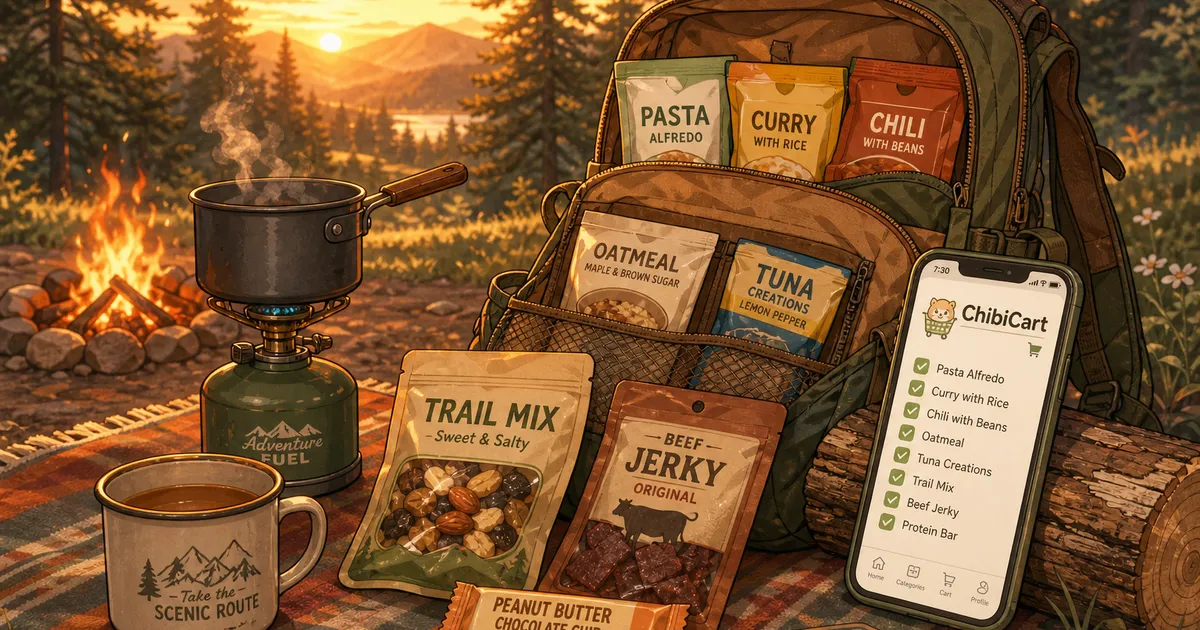
The Camping Food Checklist That Doesn't Assume You Own a Cooler
You’re standing in the grocery store aisle staring at a wall of freeze-dried meals that cost more than actual restaurant food. Your camping trip is in five days. You don’t own a cooler — or maybe you do, but it’s the size of a lunchbox and hasn’t kept anything cold since 2019.
Here’s the thing most camping food checklists get wrong: they assume you have a full camp kitchen. A two-burner stove, a 65-quart cooler, a cast iron skillet you somehow carried a mile uphill. That’s not camping — that’s relocating your kitchen to a place with more mosquitoes.
This checklist is for the rest of us. The car campers, the festival-goers, the “I said yes to a camping trip and now I need to figure out food” crowd. No cooler required. No chef skills assumed. Just 3 days of actual meals that won’t make you miserable.
What Makes a Camping Food Checklist Different?
A grocery list and a camping food checklist solve fundamentally different problems. At the store, you’re buying for a kitchen with a fridge, a stove, and running water. At a campsite, you have none of that — and possibly no cell signal to look up what you forgot.
A good camping food checklist accounts for three constraints grocery lists ignore:
- Shelf stability — everything needs to survive 3 days without refrigeration
- Minimal prep — you’re working with a single burner or just boiling water
- Pack weight and trash — you carry it in, you carry it out
This is why your regular shopping list app fails at the campsite. You need a list you can build at home, share with your camping crew, and access offline when you’re 40 minutes from the nearest cell tower.
The 3-Day No-Cooler Camping Food Checklist
Here’s a complete checklist for 2 people over 3 days. Scale up for your group — and if you’re coordinating with friends, assign sections so nobody shows up with four bags of trail mix and zero coffee.
Breakfast (Days 1-3)
- Instant oatmeal packets (6) — one per person per morning
- Granola (1 bag) — works alone or tops the oatmeal
- Instant coffee or tea bags (12) — you will want extra
- Powdered milk or shelf-stable oat milk (1 carton)
- Dried fruit (1 bag) — apricots, cranberries, or banana chips
- Peanut butter (1 jar) — the MVP of camp food
- Tortillas (1 pack of 8) — peanut butter tortilla wraps are a campsite staple
Lunch (Days 1-3)
- Tuna or chicken pouches (4) — shelf-stable, no can opener needed
- Crackers (2 sleeves) — sturdier than bread, won’t crush in your pack
- Nut butter squeeze packs (6) — single-serve, no sticky jars
- Beef or turkey jerky (2 bags) — protein that doesn’t need refrigeration
- Instant ramen or cup noodles (4) — just add boiling water
- Individual hummus cups (4) — shelf-stable sealed cups exist and they’re great
Dinner (Days 1-3)
- Instant rice packets (3) — microwave kind works with boiling water too
- Canned beans (2 cans) — black beans or chili beans, hearty and cheap
- Pasta (1 box) + jarred sauce (1 jar) — night one classic
- Instant soup packets (4) — backup meal or late-night warmer
- Shelf-stable Indian meals (2 pouches) — heat in boiling water, surprisingly good
- Olive oil (small bottle) — for cooking anything on a burner
- Salt, pepper, hot sauce packets — grab extras from your last takeout order
Snacks & Extras
- Trail mix (2 bags) — the universal camp snack
- Energy bars (6) — for hikes or when you don’t feel like cooking
- Marshmallows + graham crackers + chocolate — s’mores aren’t optional
- Hard candy or gum — surprisingly morale-boosting on day 3
- Water (2 gallons minimum) — or a filter if your site has a water source
- Electrolyte packets (6) — especially if you’re hiking
How to Coordinate Camping Food With a Group
The real challenge isn’t choosing what to eat — it’s making sure six people don’t all bring hot dogs and nobody brings a can opener.
Group camping food coordination falls apart in text threads. Someone says “I’ll bring snacks,” but snacks means different things to different people. Someone else says they’ll handle dinner but doesn’t mention they’re vegan.
The fix is simple: use a shared checklist where each person can claim items. Build the list at home, divide it into sections (breakfast, lunch, dinner, snacks, supplies), and let each person check off what they’re bringing.
ChibiCart handles this well — you can share a list with your camping crew, everyone sees updates in real time, and the list works offline once you’ve loaded it. That last part matters because you will check your list at the campsite, and you will not have signal.
The Offline Problem Nobody Talks About
Most planning apps assume you’re always connected. At a campsite, that assumption falls apart completely. You built your list at home with 5 bars of signal, but now you’re squinting at a loading spinner next to a fire ring.
A camping food checklist needs to work in two modes: connected (when you’re building and sharing it at home) and offline (when you’re actually using it at the campsite). If your list app can’t do both, you’re back to writing on the back of a gas station receipt.
ChibiCart is built as an offline-first app — your lists are stored on your device and sync when you have signal. No loading spinners at the campsite. No “couldn’t connect” errors when you’re checking off items at 7,000 feet. It sounds like a small thing until you’re the person who forgot whether you packed the instant coffee. Try it at chibicart.com before your next trip.
Quick Tips That Save Camping Meals
- Repackage everything — ditch cardboard boxes, pour dry goods into zip-lock bags, and ditch the glass jars
- Bring more water than you think — cooking, drinking, cleaning, and coffee all compete for the same supply
- Pack meals in order — day 3 dinners at the bottom, day 1 breakfast on top
- Trash bags are non-negotiable — bring 3x what you think you need
- One luxury item per person — good coffee, real maple syrup, fancy chocolate. It makes the whole trip better.
Your Camping Food Checklist Starts at Home
Memorial Day weekend is two weeks away. The campsite reservations are booked. The tent is… somewhere in the garage.
Don’t wait until the night before to figure out food. Build your camping food checklist now, share it with whoever you’re going with, and check it off as you pack. Three days of good food at a campsite isn’t complicated — it just takes a list that actually works where you need it.
The best camping meals aren’t fancy. They’re the ones where nobody forgot the coffee, everyone brought something useful, and you didn’t have to drive 45 minutes to the nearest gas station for hot dog buns you could have packed from home.