Baby Food Shopping List: Capturing Brand Decisions When Safety News Hits
It’s Thursday morning, May 22, 2026. Your kid is 11 months old. The pouch routine is dialed in: one in the diaper bag, one for the high chair, two on the pantry shelf for the days everything goes sideways.
Then Food Navigator’s headline lands — microplastics found in Nestlé and Danone baby food pouches. You read it once, screenshot it, and tell your partner over text. They reply “got it, switching brands.” 👶
You both move on with the day.
Four days later, your partner is at Target on the way home from work, standing in the baby food aisle with one minute before pickup at daycare. They don’t remember which brands the article called out. They don’t remember if you said skip pouches entirely or just those two. They grab whatever looks familiar. The decision you made together on Thursday didn’t make it to the shelf on Monday.
This is the shape of the problem. Safety news is fast. Shopping is slow. And the brand decision lives in the gap between them — usually in someone’s head, where it doesn’t survive the week.
What Is a Baby Food Shopping List?
A baby food shopping list is a shared, per-item list — pouches, jars, cereals, snacks — where each item carries a short note about the brand decision behind it: which brand to buy, which to skip, and the one-line reason why. It’s the household’s working memory for what to feed the kid, kept in the one place both shoppers actually look before they walk into the store.
It’s not a recall alert. It’s not pediatric advice. It’s just the call you and your partner already made, written down where it can’t get forgotten.
Why Brand Decisions Don’t Survive the Week Without a List
When baby food news breaks, the call gets made fast. Switch brands. Skip pouches. Try the glass jars. Ask the pediatrician at the next visit. Three or four small decisions stack up in a single Slack thread or text exchange and then everyone goes back to work.
Three things break those decisions before the next shop:
The shopper isn’t the news-reader. In most two-parent households, one person tracks the food coverage and the other does the actual store run. The decision lives in the news-reader’s head; the cart lives in the shopper’s hands. Without a written note, the link breaks.
The aisle erases context. You can hold a brand-skip rule in your head for about 24 hours. By day four, standing in front of fifteen pouch options with a tired toddler in the cart seat, you default to the package you recognize — which is exactly the brand you said you’d skip.
Two parents drift apart. One parent keeps reading the follow-up coverage. The other doesn’t. By next week, one of you has updated the rule (“actually pediatrician said pouches are fine, just rotate brands”) and the other is still operating on the original skip-everything call. The fridge fills with mismatched jars.
The list needs to carry the decision, carry the reason, and stay in sync between two phones.
How to Capture a Baby Food Brand Decision in Your Shopping List
Do this the moment you read the article. Before the screenshot, before the text. Five minutes, once.
1. Open the shared list and add the affected items by category.
Not brands yet — categories. Pouches. Jars. Puffs. Cereal. Yogurt melts. This keeps the list useful when next month’s news hits a different category. You’re building a baby food section that lives across stories, not a one-time reaction list.
2. Attach a per-item note with the actual decision.
This is the whole game. Each item gets a short note in plain language:
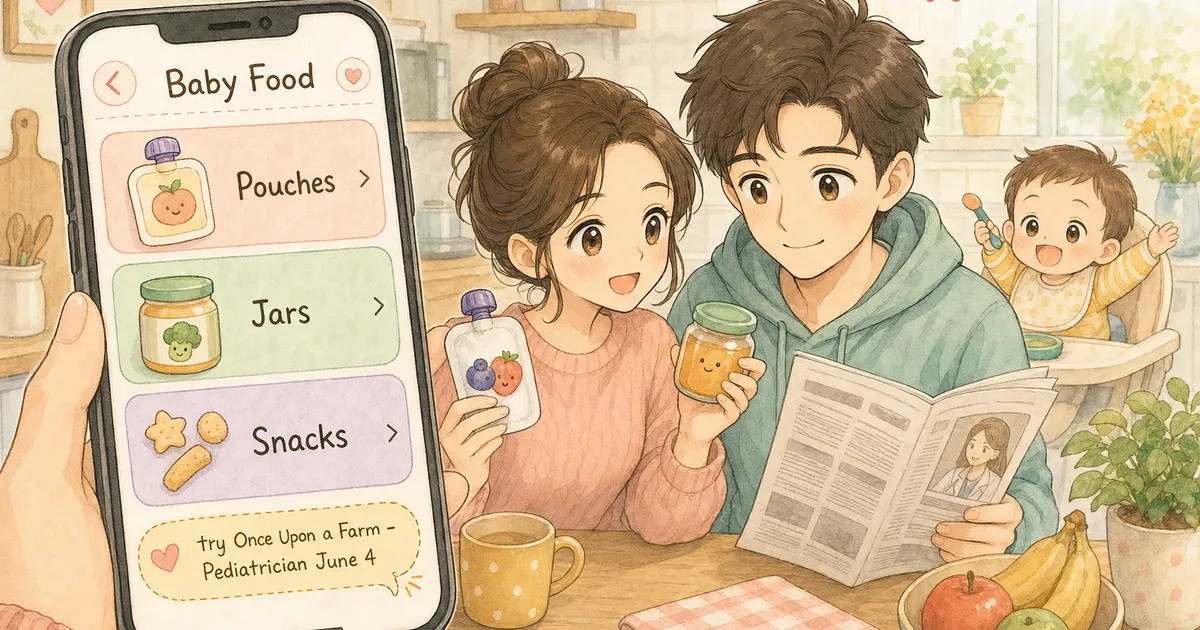
- Pouches — Skip Nestlé + Danone after Food Navigator May 22 microplastics report. Try Once Upon a Farm or Square Baby instead. Confirm with pediatrician at June 4 visit.
- Jars — Glass preferred for now. Beech-Nut and Earth’s Best are the current picks.
- Puffs — No change yet, keep current brand.
Note the shape: what to skip, what to try, and the one-line reason. Including the source and date matters more than it looks. Two weeks from now, when one of you is wondering “why did we switch again?”, the note answers itself.
3. Mark the items that need a real conversation.
Not every brand call is final after one article. Tag the open ones so they don’t accidentally become permanent rules:
- ❓ Ask pediatrician — pouches in general, frequency, any single-source signal worth a real conversation
- 👀 Trying — the new brand you’re piloting; revisit after two weeks of actual feeding
- 🚫 Skip for now — the named brands from the article, with the date attached so the rule has a shelf life
4. Share the list with the other parent — same list, both phones.
This is the part that fails in spreadsheets and notes apps. The list has to be live across both devices, so when one parent updates the pouch note after the pediatrician visit, the other parent sees the new note before their next Target run — not the next family meeting.
ChibiCart’s shared lists update across phones in real time, which is exactly the surface this needs. One list, two parents, the brand call always in sync. Both of you can open it on chibicart.com and see the same per-item notes.
5. Set a re-read date in one note, not on every item.
Safety news has a short half-life. Pick one anchor item — usually the most-bought one, like pouches — and add a note: Re-check this rule by June 8. When you hit that date, you do a five-minute review with the other parent. Some rules tighten. Some loosen. Most stay. The point is the list doesn’t become a frozen reaction to one article from May.
What This Looks Like for a Two-Parent Household
Here’s the actual shape of the list for a household with one 11-month-old, the morning the news drops:
Baby food — pouches
- Once Upon a Farm pouches (4-pack) 👀
- Trying after May 22 Food Nav report on Nestlé/Danone microplastics. Re-check by June 8. Ask Dr. Patel June 4.
Gerber pouches🚫- Skip until pediatrician visit. Not in the article but rotating brands while we figure this out.
Baby food — jars
- Beech-Nut Stage 2 (sweet potato) ✅
- Glass jar preferred. Current default.
- Earth’s Best Stage 2 (mixed) ✅
Snacks
- Happy Baby puffs ✅
- No change. Not affected by May 22 report.
Open questions for pediatrician (June 4)
- Are pouches okay in general or rotate to jars?
- Brand-specific concern or category-wide?
- How long do we hold the skip rule?
One shared list. Two parents. One toddler. The decision made on Thursday is still on the screen on Monday — and it’s still there in two weeks when the follow-up coverage lands.
Why ChibiCart Handles the Parent-Shopper List Well
The baby food list is just a normal shared list with a couple of features used hard. Here’s how each one earns its keep when the shopper isn’t the news-reader:
- Shared real-time sync — when one parent updates the pouch note after the pediatrician visit, the other parent sees the new wording before their next store run. No re-explaining over text.
- Per-item notes — every item carries the brand call, the reason, the source, and the date. The note travels with the item to the register.
- Offline support — Target’s baby aisle is in the back corner where cell signal goes to die. ChibiCart works fully offline as a PWA (a web app that works without internet), so the notes are visible and items check off whether or not you have bars.
- History view — checked-off items stay visible. When you come back to the list next week wondering “did we already try the Once Upon a Farm pouches?”, the history answers it.
- Voice input — driving home and remembering to add “ask pediatrician about iron-fortified cereal” to the open-questions list? Tap the mic and say it. Done before the next light.
No recall alerts. No brand safety scoring. No pediatric guidance. ChibiCart isn’t the source of truth for any of those — your pediatrician is. The list is just the place the call your household already made stays visible.
Try it at chibicart.com the next time a headline lands and you and your partner say “got it, switching brands.”
A Note on This Particular Story
The May 22 Food Navigator report is — at the time of writing — a single source. There hasn’t been a recall. There hasn’t been a federal advisory. The named brands haven’t responded. This is exactly the kind of news where the right move is capture the call you make, share it with the other parent, and revisit it with your pediatrician — not panic, not a pantry purge.
The shopping list isn’t a substitute for any of that. It’s the surface where whatever you decide actually reaches the shelf. ✨
Stop Making the Brand Call in the Aisle
Baby food news is going to keep happening. Pouches one month, dyes the next, plastics the one after. Each time, the rhythm is the same: a fast call, a slow week, and a tired parent in front of fifteen options trying to remember what was decided.
A baby food shopping list isn’t a fancier list — it’s a coordinated one. Split by category, shared between both parents, kept honest with one-line notes about why each brand is in or out, and revisited on a date you actually wrote down.
Set it up the next time a headline lands. Reuse the structure for the headline after that. Stop making the brand call in the Target aisle five seconds before the cart turns toward checkout.